it just has to work
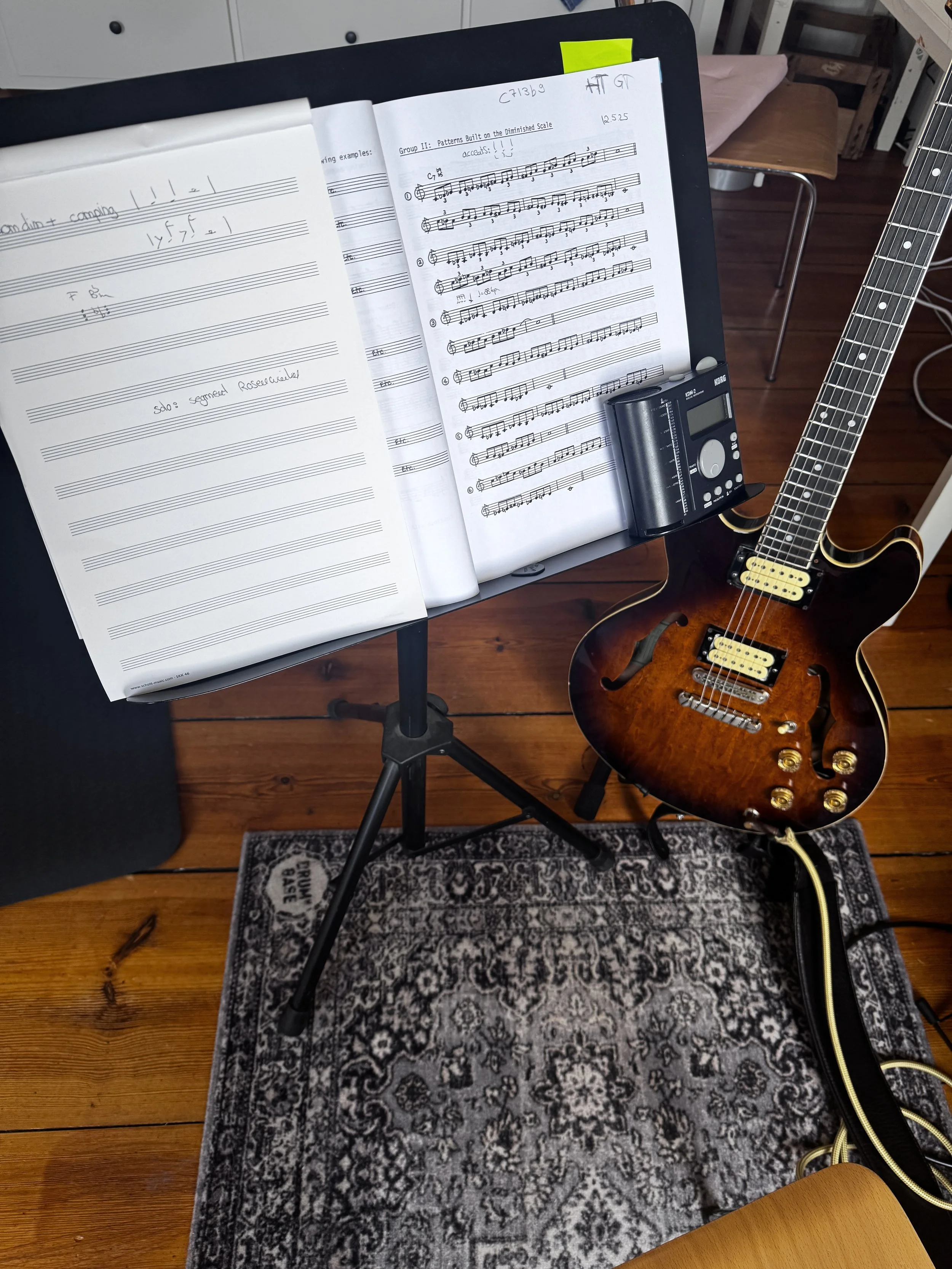
truly think that when it comes to practicing guitar and making true progress on the instrument, the mantra “it just has to work” is gold ⭐️.
So when I work on a new piece of music, I try first of all to get the basics right. We can all get so much into our heads about sounding even more “jazzy,” always playing hipper lines and cooler chords. But in the end, when we sit down to play a tune, nothing seems to work. And interestingly enough, working on the basic stuff like
a) playing a solid accompaniment (without losing the form),
b) being able to play the melody of the tune, and
c) playing a solo (even if it is in the most basic way)
will make us better.
It’s sort of a reality shock at times. We can get up so high in the clouds, listening to the most fabulous improvisers, delving into advanced jazz harmony, and then…
…we can’t play the chords of a jazz blues by heart.
So if you are serious about getting better at playing jazz guitar, my advice would be:
1. Start with the chords
Learn the chords of the tune you want to master by heart and play a basic rhythm. You could be playing quarter notes, or maybe just set the metronome to a slow tempo and only play on the one (and that’s it).
Regarding the voicings: use the ones you know and that work for you. The challenge is to play the chords of the tune by heart and repeat some choruses (at least three, I would say) without getting lost in the form.
If you have that down, record yourself a jam track. (If you do that, you are already 80% ahead of the crowd.) You can record yourself on your smartphone, but I think recording yourself with a loop pedal is the best choice.
When you record your own accompaniment, it immediately acts like a mirror. You hear how you sound, and you learn a lot from that. And please, it’s not about having a looper with 100 slots where you can store your recordings. It’s about recording a new loop every time you sit down with your guitar to practice this tune.
2. Play the freaking melody
I can’t tell you how truly freaked out I have been (and honestly still am at times) when it comes to playing the melody of a jazz standard.
It’s interesting, isn’t it? We practice scales and licks and arpeggios and whatnot all day long. Then, when it’s time to play the freaking melody, we might struggle. I mean, like a lot.
Because: how are we supposed to play the melody anyway? Possibly not exactly the way it is depicted on a lead sheet. We have liberties here! 🥶🥶🥶
And then how do we know how many liberties we can take before the melody is no longer recognizable… right?
But let’s relax. “It just has to work.”
Practice the melody as it is written on the lead sheet. Then play the melody over the chords on your looper. If you can do that, you already have a solid understanding of—and feeling for—the tune.
3. Improvise
And yes, now you can (finally) play a solo over the chords on your looper. Play anything that works for you. Forget about the notion of playing a great solo. Just improvise and try to know where you are in the form.
Because the last step of this journey would be to alternate between playing the melody (one chorus) and then improvising (one chorus) over the tune—and then after that chorus, playing the melody again.
If you can do that with any tune you are working on, you’ll know exactly what you need to work on. And the questions that arise after you’ve completed steps 1–3 are all related to a piece of music. And you can make a practice plan accordingly.